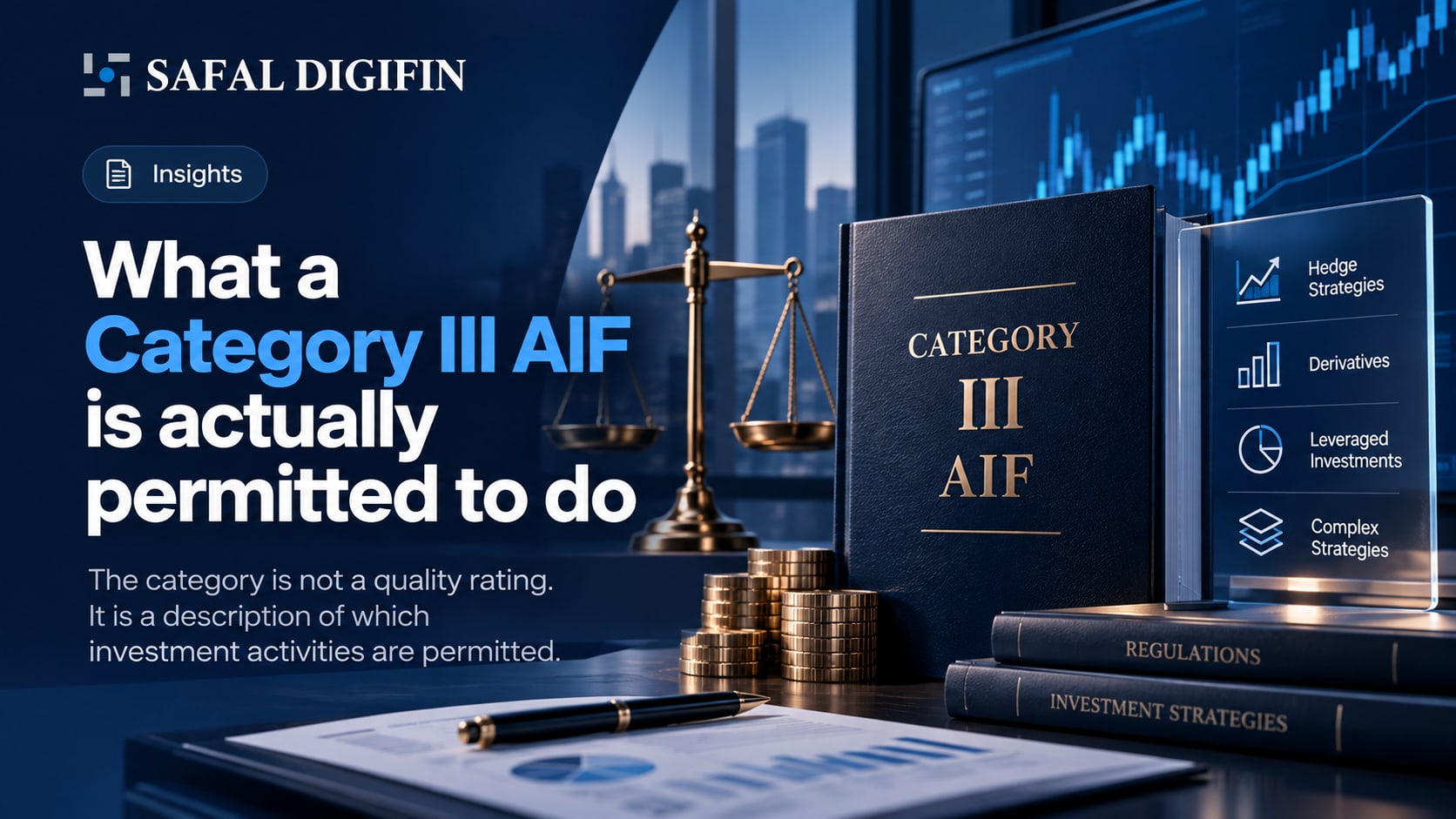
Investors often read the roman numeral as a ranking, as though Category I were the safest and Category III the most adventurous. It is not a ranking. SEBI's categories describe what a fund is allowed to hold and how it is taxed, and the number tells you almost nothing about how carefully the money is run.
The three categories, briefly
Category I covers funds directed at areas the regulator wants capital to reach: venture capital, SME, social and infrastructure funds. Category II is the residual bucket, mostly private equity and debt funds that neither take on the Category I mandate nor use leverage. Category III is the one that may trade.
Listed and unlisted equity, held together in one portfolio
Derivatives, whether to hedge an existing position or to take one
Leverage, within the limits the fund declares in its own documents
Shorter holding periods, because the strategy does not require a lock until exit
That last point is the one that matters most in practice. A Category II fund holding an unlisted position has one route out: a sale, an exit event, or a listing. A Category III fund holding the same position can hedge around it while it waits.
The tax difference is not a detail
Categories I and II have pass-through status. Income earned by the fund is taxed in the investor's hands, at the investor's rate, as though they had held the underlying themselves. Category III does not have that status.
A Category III fund pays tax at the fund level. What reaches you has already been taxed once, and that is the number your return should be measured against.
This is neither a flaw nor a benefit on its own. It simplifies your filing considerably, since the fund handles it. It also means a headline gross return is a less useful comparison against a pass-through vehicle than it first appears. Ask for the figure after fund-level tax, and compare that.
What the category does not tell you
Registration is a licence to operate under a set of rules, not an assessment of the manager. Two Category III funds may share a category and share nothing else. The things worth asking about are not in the registration number.
Whether leverage is used at all, and the ceiling the fund has set itself
How unlisted positions are valued, by whom, and how often
Where the hurdle sits and whether performance fees have a high-water mark
Who sits on the investment committee, and what they can overrule
Safal Digifin is registered as a Category III AIF. The permissions above are what the category allows; the constraints we place on ourselves are set out in the Private Placement Memorandum, which the investment team will share with you on request.
Important
This note is published for information only. It is not investment advice, an offer, or a recommendation to buy or sell any security. Investments in Alternative Investment Funds involve significant risk, including the possible loss of principal. Past performance does not guarantee future results. This communication is intended solely for sophisticated investors as defined under the SEBI (Alternative Investment Funds) Regulations, 2012. Minimum investment thresholds apply. This is not an offer or solicitation to buy or sell securities. Please read the Private Placement Memorandum carefully before investing.
Questions on this note?
Speak to the investment team